
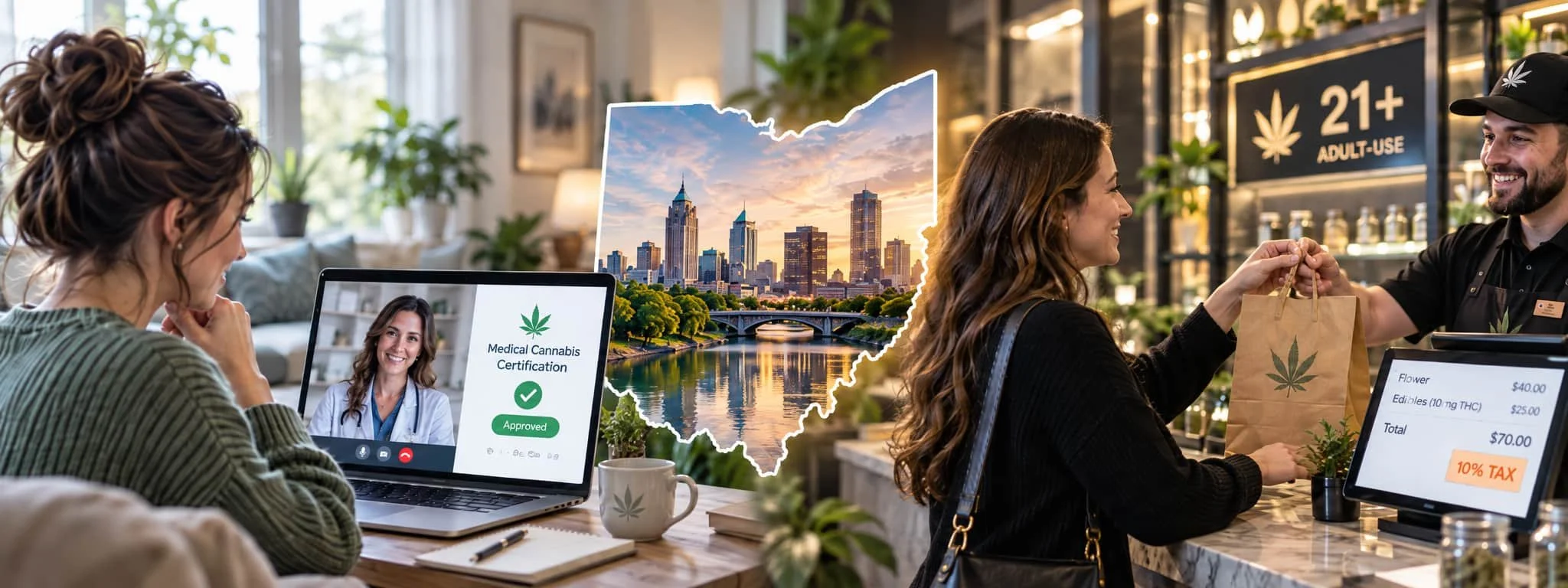
Yes, an Ohio medical marijuana card can still offer practical advantages in 2026, even though recreational cannabis is legal. Registered medical patients are not subject to Ohio’s additional 10% adult-use excise tax on medical purchases, and medical access is available to registered patients age 18 and older, while adult-use cannabis remains limited to adults 21 and older.
Ohio also maintains a separate medical patient and caregiver program with different purchase rules and certain patient protections. Eligible patients can complete the required physician evaluation online from home with an Ohio-licensed physician who holds an active Certificate to Recommend.
| Feature | Medical | Adult-Use |
|---|---|---|
| Minimum purchase age | 18+ registered patient | 21+ |
| Additional 10% adult-use excise tax | No | Yes |
| THC potency caps | 35% plant / 70% extracts | 35% plant / 70% extracts |
| Daily dispensary purchase limit | Up to 10 oz / 60,000 mg THC, unless physician-limited | Up to 2.5 oz / 15,000 mg THC |
| Registered caregiver program | Yes | No medical caregiver framework |
| Dispensary delivery | Medical delivery authorized, where available | No equivalent adult-use delivery authorization |
| Selected parental / medical-care protections | Specific protections preserved for compliant medical use | No equivalent parental-rights or medical-care protection in these provisions |
Ohio currently prohibits adult-use purchase, use and possession under age 21, while a medical patient under 18 cannot personally purchase medical cannabis, meaning the meaningful direct-purchase distinction is 18+ medical vs 21+ adult-use.
Current Ohio law applies the same basic THC ceilings to medical and adult-use products. In addition, current home-grow rights apply to adult-use consumers under statutory conditions, rather than being a distinct benefit of holding a medical card.
How Much Is Ohio's 10% Adult-Use Cannabis Tax?
Use the calculator to estimate how much Ohio's additional 10% adult-use excise tax could add to your monthly and annual cannabis purchases.
See Your Medical Tax Advantage
Medical purchases aren’t charged Ohio’s extra 10% adult-use excise tax. Enter your usual monthly purchase amount before tax to see what that difference could mean over a month and a year.
This calculator estimates only Ohio’s additional 10% adult-use cannabis excise tax. It does not include regular sales taxes, product prices, dispensary discounts, or other costs. Actual costs can vary. Medical eligibility and certification are determined by an eligible Ohio-licensed physician.
What Are the Benefits of an Ohio Medical Marijuana Card in 2026?
Even with adult-use cannabis available in Ohio, the medical program still offers several practical differences for eligible patients. The three most important are the 10% adult-use tax difference, medical access beginning at age 18, and Ohio's separate patient and caregiver framework.
1. Medical Purchases Avoid the 10% Adult-Use Excise Tax
The single largest practical difference between adult-use and medical cannabis in Ohio is how retail transactions are taxed.
Ohio levies a specific 10% excise tax on all retail adult-use marijuana transactions. This excise tax is applied on top of applicable standard state and local sales taxes. Registered medical marijuana patients purchasing through the state medical program are exempt from this 10% adult-use excise tax.
While avoiding the additional 10% adult-use excise tax reduces the taxes charged on a medical purchase, it should not be viewed as a guaranteed 10% overall discount on final store prices. Dispensaries set their own baseline retail pricing, offer distinct promotional discounts, and operate in different tax districts, all of which influence final out-of-pocket costs. However, under §3796.40, the statutory 10% excise tax strictly targets adult-use sales, meaning the additional 10% adult-use excise tax does not apply to medical purchases.
2. Medical Access Begins Before Age 21
Age restrictions create another clear distinction between Ohio's dual cannabis frameworks.
Adult-use cannabis sales, possession, and use are restricted strictly to adults who are at least 21 years old. In contrast, individuals who are at least 18 years old and have a qualifying condition can register as patients in the state program and personally purchase medical marijuana from licensed dispensaries.
Patients under the age of 18 are also permitted to participate in the Ohio medical marijuana program through a designated parent or legal guardian caregiver; however, minors cannot personally purchase cannabis at a dispensary. Because of these distinct legal tiers, the medical program provides a lawful pathway to access for adults aged 18 to 20 that adult-use rules do not offer.
Participation in the medical program requires an eligible condition. You can learn more about Ohio medical marijuana qualifying conditions to see if you meet the state guidelines.
3. Ohio Maintains a Separate Medical Patient and Caregiver Program
Beyond taxes and age limits, Ohio keeps its medical program operating under an independent regulatory structure designed specifically for patient needs.
Ohio's medical program includes a registered caregiver option for eligible patients who need assistance accessing medical cannabis. Adult-use cannabis does not have an equivalent medical caregiver program.
Ohio law also preserves specific protections for compliant medical marijuana use. For example, compliant medical use cannot by itself be the sole or primary basis for certain parental-rights decisions or a reason to disqualify a patient from medical care or a transplant waiting list.
Enrolling or keeping your registration current with an Ohio medical marijuana card ensures continued participation in these dedicated patient frameworks. If you are new to the process, you can review the steps on how to get an Ohio medical marijuana card online or visit our Ohio medical marijuana FAQ for more detail.

Ohio Medical vs Recreational Possession Rules in 2026
Ohio's medical and adult-use programs use different purchase rules, but their general possession frameworks are more similar than some older comparisons suggest. Adult-use consumers may purchase up to 2.5 ounces of plant material and cannabis products totaling 15,000 mg THC per day.
For registered medical patients, the general possession limit is also 2.5 ounces of medical cannabis plant material and cannabis products totaling 15,000 mg THC, unless the recommending physician sets a lower limit. Ohio also provides specific exceptions for transporting a larger medical dispensary purchase home and maintaining an authorized supply at the patient's residence.
What Did Ohio Senate Bill 56 Actually Change?
Senate Bill 56 became effective March 20, 2026, introducing notable statutory adjustments across Ohio's cannabis framework.
It is important to clarify that SB 56 did not create Ohio’s 10% recreational cannabis tax. The 10% adult-use tax already existed under former §3780.22. SB 56 repealed and reorganized the prior framework, and the current 10% adult-use excise tax appears in §3796.40 effective March 20, 2026.
For this medical-vs-adult-use comparison, the most relevant 2026 changes are the reorganized statutory framework, the current shared THC caps of 35% for plant material and 70% for extracts, and the updated rules governing medical and adult-use cannabis access.
So, Is an Ohio Medical Marijuana Card Still Worth It?
For eligible Ohio patients, the strongest measurable advantage is the difference in adult-use taxation. Someone who purchases regularly may see the 10% excise-tax difference add up over a year, while an occasional purchaser may see a smaller financial difference.
Other factors include age, caregiver needs and whether the person wants to participate in Ohio's medical cannabis program.
Ready to explore your options? View Ohio Medical Marijuana Card Options
Frequently Asked Questions
-
No. Adults 21 and older can purchase adult-use cannabis from licensed dispensaries without enrolling in the medical program.
-
No. The 10% excise tax applies to adult-use marijuana sales. Applicable regular taxes may still apply.
-
A registered medical patient who is at least 18 may purchase under the medical program. Adult-use cannabis remains limited to people 21 and older.
-
Not as a simple blanket rule. Ohio's general medical possession limit is 2.5 ounces of plant material and products totaling 15,000 mg THC, but medical rules also include specific exceptions for dispensary purchases transported home and authorized supply kept at the patient's residence. See the possession section above for details.
-
It may reduce taxes for registered patients because medical purchases are not subject to the additional 10% adult-use excise tax. Actual overall savings depend on purchasing frequency, product pricing and medical-program costs.