What Virginia’s Proposed Hemp THC Restrictions Could Change in 2026
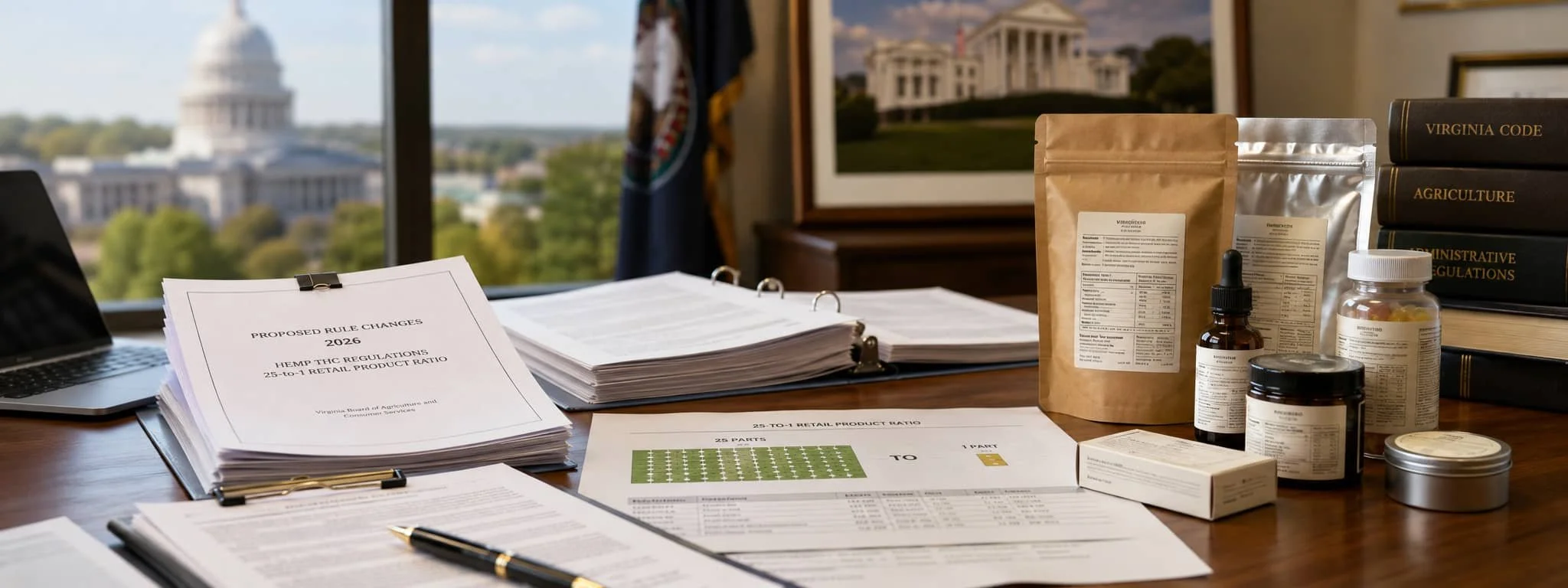
Virginia announced a proposal to end the 25:1 compliance pathway, but this is not an immediate blanket ban on all hemp products. The final effects on the market depend entirely on enacted language and implementation rules. This regulatory shift marks a major turning point for product formulation, consumer options, and retail operations across the Commonwealth.
What Did Virginia Announce on June 16, 2026?
The recently unveiled state budget framework includes sweeping modifications that directly impact how alternative cannabinoid products are sold in the state. As part of a larger legislative package, the proposed cannabis compromise includes changes to intoxicating hemp oversight designed to tighten the rules on consumer products. Most notably, the agreement would end the 25:1 pathway that previously allowed higher-THC items to sit on standard retail shelves.
Furthermore, the structural administration of these laws is set to shift. Under the new plan, regulation of industrial intoxicating hemp would transfer from the Virginia Department of Agriculture and Consumer Services (VDACS) to the Virginia Cannabis Control Authority (CCA). This consolidates cannabis enforcement under a single specialized agency. For a broader look at how this agreement fits into the state's shifting timeline, read our complete analysis of Virginia’s June 2026 cannabis compromise. However, because final legislation and implementation remain in development, the operational details are still being actively finalized by state regulators.
How Virginia’s Current 25-to-1 Hemp Rule Works
To understand what is changing, it helps to review the existing legal framework. Under the current Virginia hemp law, retail hemp products can be sold legally in traditional retail settings only if they meet strict chemical boundaries. Specifically, products must maintain a concentration of no more than 0.3% total THC by dry weight.
Additionally, the state enforces a strict package cap of no more than 2 mg total THC per package. However, an exception exists: products exceeding the 2 mg package threshold may currently qualify for legal sale through a minimum 25:1 CBD-to-total-THC ratio. When calculating these limits, "total THC" is not restricted to standard Delta-9; it includes Delta-8, Delta-9, and all other active THC isomers combined.
Mathematical Example: A package containing a total of 5 mg of total THC would currently need to contain at least 125 mg of CBD to successfully meet the 25:1 ratio pathway, while also satisfying other applicable labeling and lab-testing requirements.
What Could Change Under the New Proposal?
Ending the 25-to-1 Compliance Pathway
If the new budget provisions are implemented as outlined, the structural math allowing high-THC products into mainstream stores will disappear. Products currently relying on the CBD ratio may no longer qualify for general retail sale once the proposal is finalized and implemented. This means that items currently boasting significant amounts of THC per container will no longer be protected by their high CBD ratios, narrowing what can be lawfully sold at conventional storefronts.
Moving Intoxicating Hemp Oversight to the CCA
The proposal would consolidate relevant cannabis oversight under the CCA, stripping away the multi-agency split that previously divided hemp and medical marijuana enforcement. Rather than having VDACS handle retail hemp filings while the CCA manages dispensaries, a single unified authority will govern the entire landscape. However, this transition is a forward-looking administrative plan; the transfer has not fully occurred yet, and agencies are working through transitional operational phases.
What Remains Unclear
While the high-level policy goals have been announced, the finer details of the transition have left several critical questions unanswered for business owners and consumers alike. The elements that remain unclear include:
The final effective date for the formal product removal.
The treatment of existing retail inventory currently sitting on store shelves.
The final package and serving limits for standard non-intoxicating hemp items.
Product-specific definitions separating therapeutic hemp from intoxicating options.
The registration or licensing transition for existing storefronts.
The exact enforcement timelines and grace periods.
The final split of day-to-day administrative responsibilities between VDACS and the CCA.
Does the Proposal Completely Ban Delta-8 in Virginia?
The answer is not as simple as a blanket statement. The legality of any specific product depends entirely on its composition, milligram count, and ongoing regulatory compliance rather than its name alone. Delta-8 itself is not being singled out for a universal chemical ban; rather, products relying on the 25:1 route to bypass the 2 mg package limit will face the largest impact. If a Delta-8 product can remain under the strict milligram ceilings established for general retail, it may still have a path forward, but the final statutory text will control exactly how these items are evaluated.
Which Hemp Products Could Be Most Affected?
Because the proposal targets specific formulation loopholes, certain product categories will bear the brunt of the compliance updates:
Intoxicating gummies: Edibles that rely on high CBD-to-THC ratios to deliver noticeable servings of THC per package will likely become non-compliant.
High-THC hemp items: Any Delta-8 or hemp-derived Delta-9 products exceeding 2 mg total THC per package will face immediate retail restrictions.
Ratio-dependent formulations: Any specialty item sold under the current 25:1 pathway will need to be re-evaluated or pulled from conventional shelves.
Inhalable products: Smokeable flower, concentrates, and vapes will be subject to additional strict tracking and registration requirements under the consolidated CCA framework.
Hemp Products and Medical Cannabis Are Separate Legal Categories
It is critical for consumers to recognize that the over-the-counter hemp market and the state’s medical program operate on entirely separate tracks. They differ fundamentally across multiple operational baselines:
Regulator: Hemp is transitioning to unified oversight, while medical cannabis operates under structured pharmaceutical-processor rules.
Point of Sale: Hemp products are sold at general retail locations like vape shops, while medical options are restricted to regional dispensaries.
Access Requirements: Anyone of age can browse hemp shelves, but medical facilities require formal clinical documentation.
To see how these shifting rules impact your personal access options this year, check our detailed breakdown on whether a Virginia medical marijuana card is still worth it. For a full analysis of structural differences, see our resource on medical cannabis and hemp THC products in Virginia.
Can Virginians Still Use Licensed Medical Dispensaries?
The state’s medical infrastructure remains completely operational and unaffected by the hemp-specific rollbacks or the changing rules around retail store timelines. Purchasing products through this pathway requires a valid written certification and a current government-issued photo ID. Because licensed medical dispensaries are separate from general hemp retailers, they operate under a distinct set of state statutes that permit higher-serving formulations tailored specifically to validated patient needs. Virginia residents interested in the medical program can get a medical cannabis certification online in Virginia after an evaluation with an eligible practitioner.
What Consumers Should Check During the 2026 Transition
As the state transitions between regulatory frameworks, consumers looking to buy over-the-counter products should stay vigilant by reviewing key compliance indicators:
Total THC per package: Ensure the product does not exceed the mandatory 2 mg cap if it lacks a protective ratio.
CBD-to-total-THC ratio: Check if the item relies on the 25:1 pathway before that compliance route is officially closed.
Product label and batch information: Look for clean, clear manufacturer formatting that includes batch numbers.
Certificate of Analysis (COA): Verify that the product is backed by an independent, third-party laboratory report.
Retailer registration: Confirm the shop has filed its necessary paperwork with state authorities where applicable.
Official VDACS and CCA updates: Follow agency announcements for sudden shifts in operational policy.
Effective dates: Keep track of the final enactment timelines passed in the state budget.
| Issue | Current Virginia Framework | Announced 2026 Proposal |
|---|---|---|
| Total THC concentration | Retail hemp may not exceed 0.3% total THC | Final threshold changes require enacted text |
| Package THC pathway | No more than 2 mg total THC per package unless 25:1 ratio applies | Proposal would end the 25:1 pathway |
| Retail hemp oversight | Current framework includes VDACS oversight and retailer registration | Intoxicating hemp oversight would transfer to CCA |
| Delta-8 | Included within total THC calculations | Products relying on the ratio pathway may be affected |
| Medical dispensaries | Operate under a separate medical cannabis framework | Continue as a separate licensed channel under current information |

Frequently Asked Questions
-
No, the announced proposal targets the 25:1 pathway and intoxicating hemp oversight rather than immediately banning every hemp product. Traditional CBD items and low-THC hemp products that fit within standard package limits will remain legal for sale.
-
The current rule combines a 0.3% concentration limit and a 2 mg package threshold, but allows products to exceed 2 mg of THC if they contain at least 25 parts CBD for every 1 part THC. The new proposal seeks to eliminate this specific ratio exception.
-
A Delta-8 product may be sold only when it meets applicable total THC, package, labeling, registration, and other retail requirements. It is not banned by name, but its milligram levels must comply with state frameworks.
-
Products relying on the 25:1 pathway to offer higher THC volumes per package may be affected once final rules become effective, likely resulting in their removal from standard retail shelves.
-
No. VDACS currently imposes registration and product-compliance requirements for applicable retailers and products, meaning businesses must file disclosures and maintain accredited lab reports to operate legally.
-
The medical program operates under a separate framework, meaning patient access at licensed medical cannabis dispensaries in Virginia remains open. However, final legislation may still expand broader CCA responsibilities over time.