
Medical Marijuana Card Renewal Requirements by State (2026)
Article Key Takeaway
In 2026, medical marijuana card renewal requirements vary significantly by state, with validity periods ranging from 1 to 5 years. Once you are certified by the physicians on our platform, states like Texas and Virginia offer $0 registry fees, while others like Minnesota now provide 72-hour rapid processing.
Medical Marijuana Card Renewal Requirements: 2026 Comprehensive State Guide
Is your legal shield about to expire? In 2026, a medical card is more than just a piece of plastic - it’s your pass to tax-free medicine, higher potency products, and essential legal protection. Even as cannabis shifts to Schedule III, state-level medical programs remain the only legal pathway to maintain these exclusive benefits and stay protected.
That distinction matters. Federal rescheduling does not eliminate state requirements, nor does it replace renewal rules set by medical boards and health departments. Patients must still meet renewal timelines, complete physician recertification, and remain active in their state registry to avoid interruptions in care.
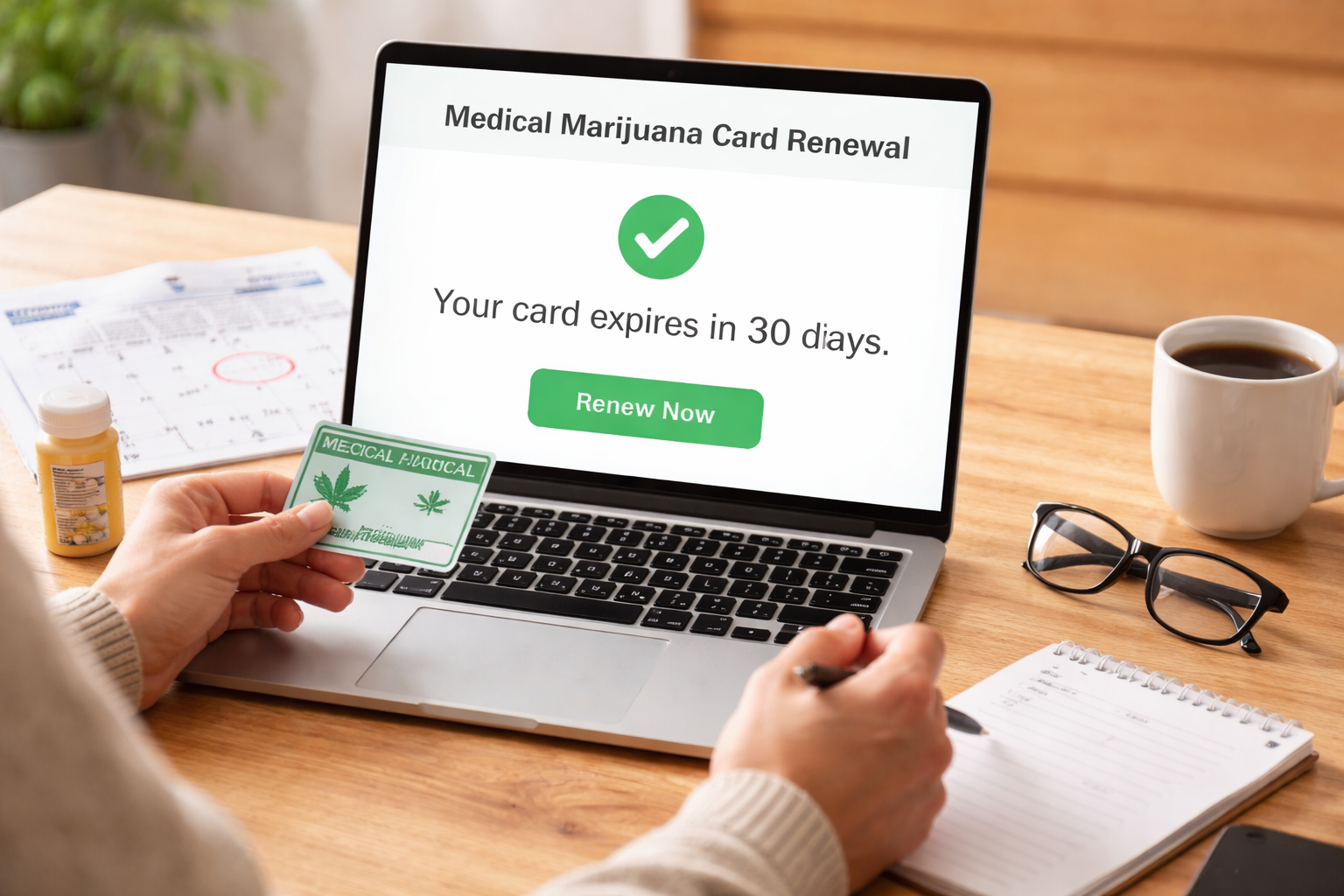
The good news is that renewals are simple. Once you understand your state's specific renewal window, the process is simple and ensures you never lose access to your medication. This guide breaks down renewal requirements by state for 2026, helping you plan ahead, stay compliant, and maintain uninterrupted legal access, no guesswork required.
Related article: Renewal vs First-Time Certification
See how much you could save with a medical card
Top Reasons to Renew Your Medical Card in 2026
For many patients, renewal isn’t just a paperwork task, it’s a practical health and financial decision. As more states expand or debate recreational access, the advantages of maintaining an active medical certification have actually become clearer, not weaker.
One of the most immediate benefits is cost savings. Medical patients typically avoid excise and recreational taxes that can exceed 20% at checkout. Over the course of a year, that difference alone often outweighs the entire renewal cost. In addition, medical programs usually allow higher potency products, broader formulations, and access to items that may not be available, or appropriate, under adult-use rules.
Renewal also provides legal safeguards, particularly in employment and compliance-sensitive environments. Many state medical statutes include explicit protections for registered patients that recreational laws do not offer, especially when use is tied to a documented medical need and physician oversight.
From a care perspective, renewing your certification functions as a form of health maintenance. A renewal visit gives you the opportunity to review symptom changes, adjust dosing, and confirm that your qualifying condition is still being managed safely and effectively. The physicians on our platform streamline this process through compliant evaluations designed to minimize disruption while maintaining clinical integrity.
Ultimately, the core reasons to get medical card renewal in 2026 come down to continuity, protection, and value. Staying current ensures uninterrupted access to regulated medicine, on your terms, within the law, and with professional medical guidance supporting every step.

2026 Medical Marijuana State Fee and Validity Comparison Instruction
| State | State Approval Time | Medical Card Type | Validity Period |
|---|---|---|---|
| Virgina | Instant (Digital) | Digital Only | 1 Year |
| Texas | Instant (Digital) | Digital (Registry) | 1 Year |
| Minnesota | 72 Hours | Digital Only | 3 Years |
| Ohio | 24 Hours | Digital | 1 Year |
| Connecticut | 48–72 Hours | Digital | 3 Years |
| Kentucky | 24–48 Hours | Digital | 1 Year |
| Missouri | 24–48 Hours | Digital | 1 Year |
| Pennsylvania | 3–5 Days | Hard Copy (Mail) | 1 Year |
| Arizona | 3–5 Days | Digital | 2 Years |
| Georgia | 7–10 Days | Hard Copy (Mail) | 5 Years |
| Oklahoma | 10–14 Days | Hard Copy (Mail) | 2 Years |
Related Article: MMJ Card Costs by State: The 2026 Patient Value Guide
In states that allow telehealth evaluations, some patients may be able to complete the renewal process much faster than expected. Many people researching online renewals also ask can you renew your medical marijuana card same day depending on provider availability and state rules.
State-Specific Renewal Deep Dives
Oklahoma (OK)
Many patients still ask whether adult-use legalization changes access rules, but the reality is that dispensary purchases require an active Oklahoma Medical Marijuana Card regardless of ongoing recreational debates. Even as lawmakers revisit broader cannabis policy, medical authorization remains mandatory for lawful purchase and possession through licensed dispensaries. After paying the $104.30 state fee, or $22.50 for Medicaid or Medicare recipients, your renewal is approved for a two-year validity period, providing long-term stability with relatively infrequent renewals.
Texas (TX)
For patients researching how to get a medical card in Texas, renewal works very differently than in most states. Texas charges a $0 state fee and does not issue physical cards at all. Instead, the physicians on our platform update the state’s Compassionate Use Registry of Texas (CURT) directly; once your profile is refreshed in the system, your Texas Medical Marijuana Card status is legally active for another year with no additional steps required from the patient.
Pennsylvania (PA)
A common renewal question is where is my medical card number PA patients need for payments and dispensary verification. The answer is simple: the number appears on the front of your physical medical ID card. While the state offers phone assistance at 877-395-8930, most patients find renewals faster through the online portal; once the $50 state fee is paid and the physician submits recertification, your Pennsylvania Medical Marijuana Card is fully renewed.
Minnesota (MN)
Minnesota now stands out nationally for speed and simplicity. Following physician approval, state processing averages just 72 hours, a major improvement for patients planning around expiration dates. There is no state registry fee, and renewals benefit from a generous three-year validity period, making the Minnesota Medical Marijuana Card one of the lowest-maintenance programs available in 2026.
Georgia (GA)
Georgia’s program prioritizes long-term legal protection over frequent renewals. With a modest $25 state fee, patients receive an industry-leading five-year renewal window, significantly reducing administrative burden. For eligible patients, maintaining an active Georgia Medical Marijuana Card offers extended compliance and peace of mind unmatched by most other states.
Kentucky (KY)
The Kentucky medical marijuana program 2026 represents the state’s transition from temporary access to a permanent regulatory framework. Standard renewals carry a $25 fee, but patients who held state-issued temporary permits in 2025 qualify for a $0 renewal, easing the shift into the new system. As implementation continues, renewal timelines are expected to stabilize into a predictable annual cycle.
Other Notable State Renewal Rules (Quick Overview)
Virginia continues to rely on physician-driven renewals tied to Virginia medical card requirements, with no physical card issuance.
Ohio patients should plan for the Ohio MMJ registry fee 2026, which remains separate from physician recertification.
Arizona offers a reduced renewal option through the Arizona medical card renewal SNAP discount, lowering costs for qualifying patients.
Missouri provides extended continuity through Missouri medical card 3 year validity, reducing renewal frequency.
Connecticut maintains a $0 state fee, while West Virginia follows a standard annual renewal structure.
Together, these state-level differences underscore why understanding your specific renewal rules is essential for uninterrupted, compliant access in 2026.
Some states allow fast online renewals, while others still require additional registry steps or stricter provider evaluations. Understanding the current state laws that affect your renewal timeline can help patients avoid unnecessary delays before their card expires.
How to Use Telemedicine for Your 2026 Renewal
Renewing your certification through cannabis medical card online services has become the preferred option for patients who value speed, privacy, and convenience. In states where telehealth is permitted, such as Virginia, Pennsylvania, Ohio, and several others, renewals can be completed entirely from home without in-person clinic visits or paperwork delays. State regulators allow this model because it preserves physician oversight while removing unnecessary logistical barriers for patients managing ongoing conditions.
The physicians on our platform conduct 100% remote video evaluations where allowed by state law, ensuring compliance with medical and legal standards while keeping the process efficient. During your appointment, the provider reviews your current condition, confirms continued eligibility, and documents any updates required for renewal. This maintains the required clinical relationship without disrupting your routine.
Once your video appointment concludes, our team handles the medical documentation immediately. Physician certifications are submitted or registry profiles are updated without delay, reducing the risk of expiration gaps and ensuring continuous legal access to dispensaries. For 2026 renewals, telemedicine remains the most reliable way to stay compliant while minimizing time, travel, and administrative stress.
Final Thoughts: Stay Certified, Stay Legal
Medical cannabis access in 2026 is less about headlines and more about compliance. Even as federal policy evolves, state programs still control who can purchase, possess, and use medical cannabis legally. Allowing a certification to lapse, even briefly, can interrupt treatment, increase costs, or force patients into noncompliant alternatives that carry unnecessary risk.
The good news is that renewal is predictable when handled correctly. Every state operates on a defined renewal cycle, and most allow patients to begin the process well before expiration. Planning ahead protects your access, preserves legal safeguards, and ensures continuity of care without last-minute stress.
Don’t wait for your 1, 2, or 5-year window to close. Once you are within 60 days of expiration, schedule your renewal evaluation with the physicians on our platform to maintain your status. Staying certified isn’t just administrative, it’s how you stay legal, protected, and in control of your care.
Frequently Asked Questions
-
Veterans often qualify for the same income-based renewal discounts available to other patients. For example, Pennsylvania offers reduced costs for patients enrolled in SNAP or WIC, while Oklahoma provides a significantly lowered state fee for patients on Medicaid or Medicare. These programs can substantially reduce renewal expenses, making it easier for veterans on fixed or limited incomes to stay compliant and maintain uninterrupted access to their medication.
-
Some states recognize out-of-state medical certifications through reciprocity or temporary “guest patient” programs. This means that once you hold a valid card from one of our supported states, you may be eligible to purchase medical cannabis in certain other states while visiting. Rules vary by location, so eligibility depends on the destination state’s medical cannabis laws and registration process.
-
Processing times vary widely by state. Some programs are nearly immediate, with renewals finalized in as little as 72 hours, while others can take longer due to registry updates or mailing requirements. In slower systems, patients should plan for up to 14 days to ensure their renewal is completed before expiration.