Post-Traumatic Stress Disorder (PTSD) is one of the most commonly recognized qualifying conditions in medical cannabis programs across the United States. Many patients can complete the evaluation process online and receive guidance on their eligibility under state law. Because eligibility varies by state, the criteria required to establish a qualifying condition can look significantly different depending on your location. Online evaluations are common and provide a secure, streamlined path for individuals looking to speak with a practitioner from home, but medical cannabis laws differ by jurisdiction, meaning rules regarding registration, possession limits, and product types are subject to change based on local legislative updates.
Does PTSD Qualify for a Medical Marijuana Card?
PTSD qualifies for medical cannabis in most state programs, either as an explicitly listed condition or through provider discretion. Understanding how your specific jurisdiction categorizes this condition is the first step toward obtaining a medical card.
Listed-Condition States vs. Provider-Discretion States
In the majority of jurisdictions with an active medical cannabis framework, state legislatures have formally included PTSD on the official list of qualifying medical conditions. In these listed-condition states, a state-licensed practitioner must formally confirm a diagnosis of PTSD within your medical history during your evaluation before submitting a certification to the state registry.
Conversely, some jurisdictions use a provider-discretion model. In these states, the law does not restrict cannabis recommendations to a rigid list of diagnoses. Instead, state-licensed practitioners are granted the legal authority to determine whether a patient might benefit from medical cannabis based on their overall clinical judgment and health history.
State-Specific Frameworks for PTSD Eligibility
Virginia: PTSD is currently a qualifying condition for medical marijuana in Virginia, so individuals experiencing symptoms related to PTSD can schedule their appointment any time. Virginia operates under a full provider-discretion framework. The state does not maintain an explicit list of qualifying health conditions. Instead, individuals seeking a medical cannabis path must meet with a registered practitioner who evaluates their health history and determines eligibility based on clinical discretion. To understand the complete administrative steps in the Commonwealth, review the current Virginia medical card requirements.
Texas: Under the Texas Compassionate Use Program (TCUP), PTSD is explicitly recognized as an approved qualifying condition. Patients must be permanent Texas residents and obtain a prescription from a specialist registered with the Compassionate Use Registry of Texas (CURT).
Pennsylvania: The Pennsylvania Department of Health explicitly lists Post-Traumatic Stress Disorder as a qualifying serious medical condition. Individuals must register with the state database and obtain an online certification from an approved practitioner.
Oklahoma: Oklahoma does not use a fixed list of qualifying conditions.. The state medical program does not restrict certifications to a predetermined list of illnesses, meaning licensed providers have complete clinical discretion to certify patients for PTSD based on individual evaluations.
Ohio: The Division of Cannabis Control in Ohio includes PTSD as an official qualifying condition. To qualify, an applicant must establish a bona fide relationship with a certified physician who submits the approval directly into the state's electronic registry.
Minnesota: The Minnesota Office of Cannabis Management lists PTSD as an approved condition. Residents must complete an assessment with a participating provider who confirms the diagnosis within the state's secure electronic tracking system.
How to Get a Medical Marijuana Card for PTSD
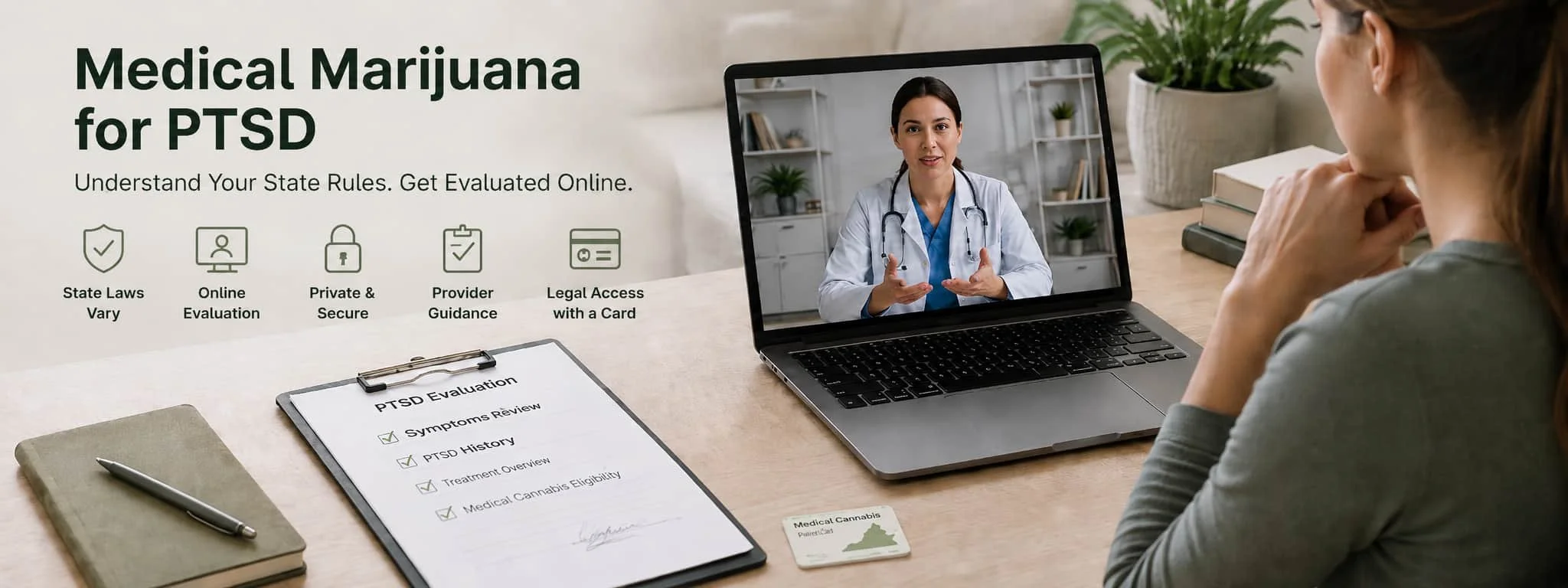
Most patients can complete the PTSD medical marijuana evaluation process online in a few simple steps. The modern telemedicine framework allows individuals to securely connect with state-licensed practitioners from the comfort of home.
1.Schedule an evaluation
Select an online telemedicine platform operating in your state and book an appointment time that fits your schedule. You may be asked to complete a standard intake form detailing your basic health history and any existing documentation related to your PTSD diagnosis.
2.Meet with a licensed provider
Attend your virtual consultation with a state-licensed practitioner. During this session, the provider will review your medical records, discuss your PTSD diagnosis, health history, and current concerns, explain relevant state regulations, and determine whether medical cannabis is an appropriate option for your situation.
3.Receive certification when approved
When the state-licensed practitioner determines you meet the state eligibility criteria, they will issue an official medical cannabis certification. In many states, this approval is uploaded directly into the state's electronic patient database immediately following your evaluation.
4.Complete state registration when required
Depending on local laws, you may need to log into your state’s medical cannabis portal to finalize your registration, upload a government-issued ID, and submit any required state application fees. The state will then issue your digital or physical medical cannabis card.
5.Visit a licensed dispensary
Once you possess an active state registration or digital card, you can legally visit licensed medical dispensaries within your state borders. Dispensing staff can assist you in selecting regulated products that comply with the purchase and possession rules in your state.


What Research Says About Medical Cannabis and PTSD
Researchers continue to study the relationship between PTSD, chronic stress, sleep disturbances, and the endocannabinoid system. Clinical studies remain ongoing globally to better understand how the active compounds in cannabis interact with human biology, though outcomes and experiences can vary widely between individuals.
Must read: VA National Center for PTSD: Cannabis Use and PTSD Among Veterans
Sleep Disturbances and Nocturnal Patterns
Many PTSD patients seek options related to recurring nightmares and disrupted sleep. Clinical researchers are interested in how specific cannabinoids interact with sleep architecture, particularly sleep patterns associated with dreaming and nighttime awakenings. While individual experiences depend heavily on product types and serving sizes, sleep disruption remains one of the primary reasons individuals discuss medical cannabis programs with their physicians.
Heightened Stress Responses and Hypervigilance
Some patients explore medical cannabis because of persistent feelings of alertness and trigger-related stress. The physiological state of hypervigilance, characterized by a constant, elevated state of fight-or-flight awareness, is a core component of the daily experience for many living with trauma. Researchers are studying how cannabinoids interact with signaling systems involved in stress responses , though research has not conclusively established a standard clinical outcome.
The Endocannabinoid System (ECS)
The human body contains a complex cell-signaling network known as the endocannabinoid system (ECS), which plays a role in regulating a variety of functions, including mood, memory, sleep, and how we process stress. Ongoing research involving stress regulation and the ECS focuses on how external cannabinoids bind to CB1 and CB2 receptors throughout the brain and central nervous system. Scientists are investigating whether severe or prolonged stress can impact natural endocannabinoid levels, though the long-term effects are still not fully understood.
PTSD Medical Card Requirements by State
PTSD is recognized by major medical cannabis programs including Texas, Pennsylvania, Oklahoma, Ohio, and Minnesota, while Virginia allows provider-based eligibility determinations.
The table below provides a comparative look at how these state frameworks operate.
| State | PTSD Explicitly Listed? | Card Type / Registry | Key Restrictions & Rules |
|---|---|---|---|
| Virginia | No (Provider Discretion) | Electronic written certification through the Virginia CCA Portal | Virginia medical card requirements do not require state registration; patients must have a valid written certification and government-issued identification to purchase from a licensed dispensary. |
| Texas | Yes | CURT Electronic Registry | The Texas medical marijuana card program restricts access to non-smokable forms like tinctures, lozenges, and limited vaporization products. |
| Oklahoma | No (Provider Discretion) | Physical Patient License | An Oklahoma medical marijuana card requires state portal registration. Providers have full authority to recommend cannabis for any condition. |
| Pennsylvania | Yes | Physical Registry Card | To obtain a Pennsylvania medical marijuana card individuals must register with the state and pay a separate state issuance fee. |
| Ohio | Yes | Electronic Patient Registry | An Ohio medical marijuana card features a $0 state registration fee as of recent updates, requiring annual renewals with a certified practitioner. |
| Minnesota | Yes | Digital Registry Enrollment | A Minnesota medical marijuana card involves formal practitioner enrollment in the Office of Cannabis Management database. |
Ready to Find Out Whether You Qualify?
The physicians on our platform can help you navigate your state's specific legal requirements and review your eligibility for a medical card from home.
Veterans, PTSD, and Medical Cannabis: Federal vs. State Rules
Veterans may participate in state medical cannabis programs without losing access to VA healthcare benefits. Because cannabis remains classified as a Schedule I controlled substance under federal law, navigating the intersection of federal veteran benefits and local state programs requires a clear understanding of official policies.
For current federal guidance, review the U.S. Department of Veterans Affairs: What Veterans Need to Know About Marijuana.
The Role of VA Physicians
Under current Department of Veterans Affairs policy, VA clinicians cannot recommend medical cannabis or complete the forms required for participation in a state medical cannabis program. Because the VA operates under federal law, this restriction applies even in states where medical cannabis is legal, and VA staff must adhere to federal guidelines regardless of the specific Medical Marijuana Laws by State . Veterans who want to pursue certification must meet with a state-licensed practitioner outside the VA healthcare system.
Open Communication Policies
Despite the restriction on writing certifications, veterans are explicitly encouraged to discuss cannabis use with their VA providers. VA policy emphasizes that open communication is vital for maintaining comprehensive healthcare records, tracking potential medication interactions, and ensuring overall patient safety. VA clinicians are instructed to document a patient's use of medical cannabis within their electronic health files without judgment or administrative penalty.
Impact on VA Healthcare Benefits
A common concern among veterans is whether participating in a state program will cause a loss of their hard-earned medical benefits or disability compensation. Official VA directives confirm that state-legal participation does not automatically affect benefits. Veterans will not be denied VA healthcare services or clinical access simply because they hold a valid state medical cannabis card. However, because state law still governs eligibility and possession rules locally, veterans must ensure they remain in strict compliance with the specific regulations established by their home state.
Federal Property Warning: It remains a federal crime to possess, use, or transport cannabis products onto any federal property, including VA hospitals, national cemeteries, military bases, and federal veteran housing complexes, regardless of state card status.
Veteran Program Guidance
If you are a veteran looking to explore your state’s medical program safely and legally, state-licensed practitioners are available to guide you through the outside certification process while keeping your privacy secure.
Privacy, Employment, and PTSD Medical Cards
Medical cannabis registrations are generally treated as private medical information, although employment protections vary by state. Understanding how your data is protected and where limitations exist is critical prior to scheduling an evaluation. Because cannabis regulations cross multiple jurisdictional boundaries, patients must recognize that a medical card does not offer blanket protection across all areas of civil, professional, and federal life.
HIPAA Considerations and Registry Privacy
A widespread misconception is that public employers, background check agencies, or neighbors can freely search a medical marijuana database to see who holds a card. In reality, state medical cannabis registries are highly secure, confidential databases managed directly by state departments of health or dedicated cannabis control divisions.
However, when discussing the intersection of health privacy and state tracking systems, it is vital to understand where federal law ends and state statutes begin:
The HIPAA Distinction: The clinical consultation between a patient and a state-licensed practitioner is a confidential encounter protected under the strict standards of the Health Insurance Portability and Accountability Act (HIPAA). This means a provider cannot share your qualifying condition or health history with outside entities without your express consent. However, state-administered medical cannabis registries are created under state law rather than federal jurisdiction, meaning federal HIPAA rules do not directly govern the state's internal patient databases.
State Legislative Protections: Despite operating outside the federal HIPAA umbrella, state legislatures deliberately craft medical cannabis statutes with severe confidentiality mandates. For example, states like Pennsylvania, Missouri, and Florida explicitly state in their regulatory frameworks that patient data is confidential and completely exempt from public records requests.
Authorized System Access: Information within a state registry is tightly controlled. Access is generally restricted to authorized regulatory personnel, dispensing staff verifying a card's validity during a face-to-face transaction, and specific law enforcement personnel.
Law Enforcement Parameters: Police access to your patient status is not uniform and varies by jurisdiction. In some states, officers can only query the system after an individual has been stopped or arrested, or if they have reasonable suspicion of a program violation. In other states, law enforcement personnel have immediate access via 24/7 online verification systems to confirm the legitimacy of a card presented during an encounter. No state currently links active medical cannabis registry data directly to standard Department of Motor Vehicles (DMV) roadside barcode scans.
Workplace Drug Testing and Employment Protections
While your status as a registered patient remains confidential within the state framework, the presence of a medical card does not grant universal immunity in the workplace. Workplace drug screening remains one of the most complex landscapes for medical cardholders. Employment protections vary significantly across state lines, and federal regulations introduce distinct hurdles that can impact your job security:
Employment Protections Vary: Some states have enacted strict laws prohibiting employers from discriminating against job applicants or employees solely based on their status as a registered medical cannabis patient, or for testing positive for cannabis metabolites during off-duty hours. However, other jurisdictions maintain traditional "at-will" employment frameworks that provide zero statutory workplace protections for medical cardholders, meaning an employer may legally terminate a worker for a positive drug screening regardless of their underlying medical condition.
Safety-Sensitive Disqualifications: Even in states with robust protective legislation for patients, exemptions almost always exist for safety-sensitive roles. Positions involving heavy machinery operation, healthcare procedures, commercial driving, or public safety are rarely protected from adverse employment actions related to cannabis use. Employers generally retain the full legal right to maintain zero-tolerance policies for positions where impairment could pose a direct threat to workplace safety.
Federal Contract Compliance: A common source of confusion involves the federal Drug-Free Workplace Act. This act requires federal contractors with agreements of $100,000 or more, as well as all federal grant recipients, to maintain a structured, drug-free workplace environment. While the Act mandates clear corporate policies, drug awareness programs, and notifications regarding workplace drug convictions, it does not explicitly require random drug testing. However, because federal law historically classified cannabis as an illicit substance, many covered employers implement strict zero-tolerance drug testing panels to ensure compliance and protect their federal funding lines.
The Impact of Federal Rescheduling
The rules around jobs and medical cannabis are changing quickly, especially now that the federal government has officially moved medical marijuana to Schedule III of the Controlled Substances Act. While reclassifying it is a huge shift in federal policy, what it actually means for your daily job protections is a bit of a mixed bag:
The ADA and Accommodations: Historically, the Americans with Disabilities Act (ADA) explicitly excluded protections for individuals using cannabis because it was classified as a Schedule I substance with no accepted medical use. With medical cannabis products lawfully manufactured and distributed under a state license now occupying Schedule III, it is no longer categorically classified as an "illegal drug" under federal law for those with valid authorizations. Consequently, legal experts suggest that employers may increasingly be required to evaluate medical cannabis use through standard ADA frameworks, including entering an interactive process to determine if reasonable off-duty accommodations can be made for a patient's underlying disability.
Safety and On-the-Job Impairment: It is critical to emphasize that federal rescheduling does not give employees the right to use, possess, or be under the influence of cannabis while on the clock or on work premises. Employers remain completely free to prohibit workplace impairment and enforce strict safety standards.
Department of Transportation (DOT) Exceptions: For individuals working in safety-sensitive positions governed directly by federal agencies, such as commercial truck drivers, airline pilots, train operators, and transit workers, the rules have not changed. The Department of Transportation continues to enforce a strict ban on all cannabis use, meaning a positive test result will result in immediate disqualification from these roles regardless of state medical card status or federal Schedule III reclassification.
To gain a comprehensive understanding of how your career and living situation may interface with your patient status, read our detailed guide on Employment & Housing Protections. If you are concerned about mandatory workplace screenings, explore our resources answering Will I Fail a Drug Test at Work? to learn how metabolites are processed by the body.
Why PTSD Patients Choose Medical Cannabis Programs
Many PTSD patients explore medical cannabis programs because they provide legal access to regulated products under state supervision. Choosing a formalized state program offers distinct advantages over alternative avenues.
Legal Access to Licensed Dispensaries
Enrolling in a formal state program provides individuals with specific legal safe harbors under local law. Cardholders can transport and possess personal amounts of cannabis within state lines without facing state-level misdemeanor charges or civil penalties that might apply to unregulated possession.
Access to Regulated Products
Products sold within state-licensed dispensaries must undergo mandatory independent laboratory testing before hitting shelves. This process ensures that consumers have access to detailed cannabinoid profiles, accurate THC percentages, and clear labeling, while verifying that the products are completely free from harmful contaminants, heavy metals, mold, or residual solvents.
Telemedicine Evaluations
The availability of secure online appointments has lowered the barrier to entry for individuals who find traditional medical environments stressful. Telemedicine allows a patient to discuss sensitive personal health histories and trauma indicators privately with an empathetic, state-licensed practitioner.
Patient Privacy Protections
State programs ensure that your participation remains confidential. By prioritizing data security and restricting registry access to healthcare providers and state compliance officials, programs allow individuals to explore options without fear of public exposure.
State-Specific Legal Protections
Many states include legal provisions designed to safeguard patients in specific civil scenarios. Depending on where you live, holding an official medical card can offer structural support during local housing disputes, child custody evaluations, or state-level administrative reviews, helping protect your fundamental rights as a patient.
Take the Next Step Safely
Navigating the regulatory landscape of medical cannabis can seem overwhelming, but you do not have to figure it out alone. Licensed providers are available online to evaluate your health history, answer your legal questions, and guide you through your state's official enrollment process.
Frequently Asked Questions
-
To qualify for a card, a state-licensed practitioner must confirm an official diagnosis of PTSD based on established diagnostic criteria. While symptoms themselves are not listed individually by states, providers routinely evaluate the presence of intrusive thoughts, severe avoidance behaviors, hypervigilance, and related conditions like chronic Anxiety & Depression or severe Insomnia during your consultation.
-
Yes. Veterans can legally participate in state-level medical cannabis programs. However, because federal law prohibits VA staff from completing state certifications, veterans must obtain their official recommendations by scheduling an evaluation with a state-licensed practitioner outside of the VA hospital network.
-
In many states, yes. Telemedicine platforms allow patients to meet securely via video conference with a qualified provider to review medical records, discuss symptoms, and receive an electronic state certification from home.
-
No, state medical cannabis registries are highly confidential and protected by strict privacy laws. Employers do not have access to search these databases. However, a card does not prevent an employer from conducting random drug testing, and positive results can still lead to workplace penalties depending on your state's laws and your specific job duties.
-
Medical cannabis registries are generally not open to the public. Access is usually limited to authorized state agencies, healthcare providers, dispensaries, or law enforcement, depending on state law.
-
Yes, under a provider-discretion model. Virginia does not use an explicit list of qualifying conditions. Instead, any state-licensed practitioner registered with the state can issue a medical cannabis recommendation for PTSD if they believe it is appropriate for the patient's health plan.
-
Yes. Texas formally added PTSD to its explicit list of qualifying medical conditions under the Texas Compassionate Use Program (TCUP). Texas residents can obtain a prescription by meeting online with a registered TCUP specialist.
-
The evaluation itself usually takes 10 to 15 minutes. Once approved, the time required to receive your actual card varies by state. Some states issue a digital certificate immediately, while others require a manual state review process that can take anywhere from a few days to a couple of weeks.